
Agents
Your AI agents never tell each other what they learned
A summary travels between your agents and the reason stays behind. SmartMemory gives the whole team one notebook that every agent reads and writes, and that outlives the job.
pip install smartmemory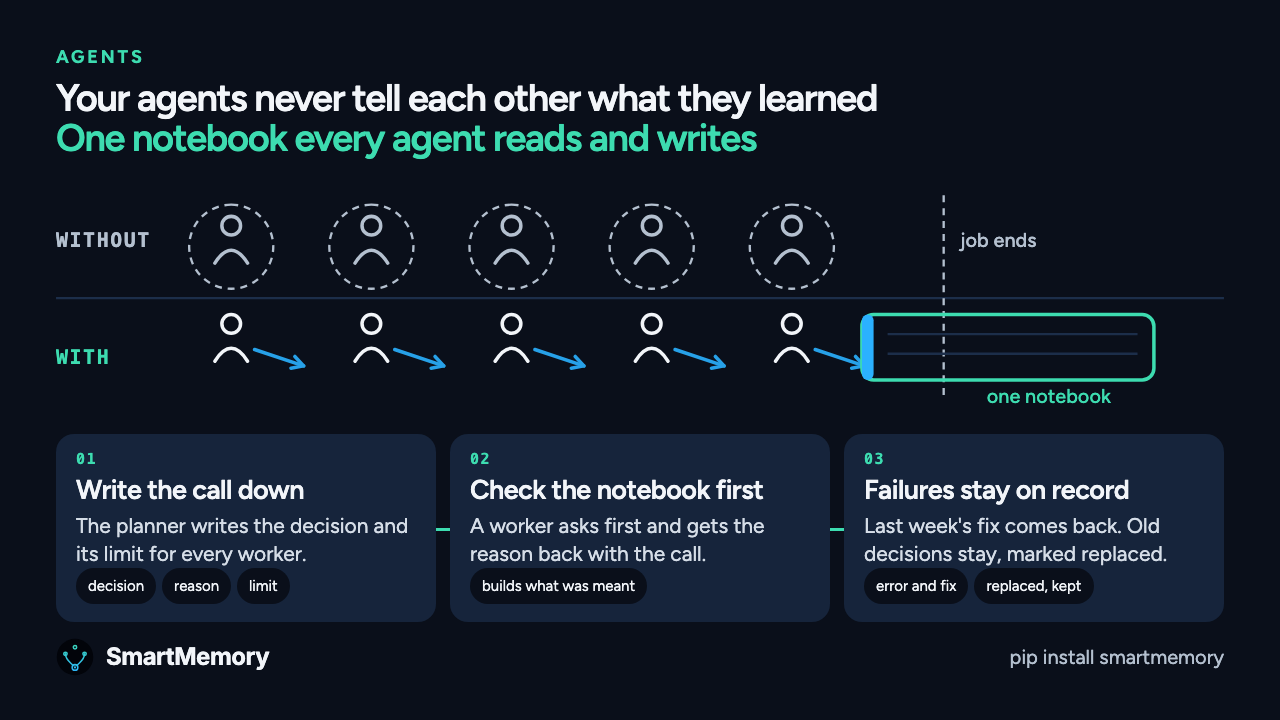
One week of an agent team, run twice
Read the transcript
Your company is putting AI agents to work. Not one, a team of them, with a coordinator handing out the work. Each one is smart. Each one is careful. Each one reads everything it is handed. Here is the part nobody tells you.
What one of them learns, the others do not know. And when the job ends, what the team learned doing it goes with it.
Meet the team. Four AI workers and a coordinator, shipping one change to a payments system. One plans the work. One builds it. One checks it. One ships it.
The coordinator passes the work between them. That is a good team, built the way you would build a human one, because the job is bigger than any one of them. But each worker only knows what is in the handoff it receives. Whatever did not fit in the handoff, for that worker, never happened.
Monday. The planner makes a smart call. Move the customer accounts five hundred at a time, no more than once a minute. The system can safely take about a thousand requests a minute, so five hundred leaves half of that spare. The planner knows all that. But what travels to the next worker is a summary, and the summary just says batches.
Tuesday. The builder gets the summary, sees batches, and picks a size ten times bigger, because nothing said otherwise. Wednesday. The checker reads the work, checks it against everything written down, and finds nothing wrong. Because the reason was never written down. Thursday.
The shipment runs straight into that safety limit and fails, and the afternoon goes to figuring out why. Here is the worst part. The builder hit this exact failure last week, on a different job. Fixed it, moved on. And because that was a different job, nothing carried the lesson across. And when a new worker joins Thursday afternoon and asks the simplest question in the building, what is the batch size, it gets three different answers.
Nobody on this team was careless. The reason simply was not in anything they were handed. If this sounds like every big project you have ever run with people, that is the point. Except your people carry what they learned to the next project. These workers, on their own, do not.
Now watch the same week with one change. The team gets a shared memory. Think of it as the team's notebook, one that every worker reads and writes, and that outlives the job. Monday. The planner makes the same call, and this time writes the decision in the notebook, with the reason next to it. Five hundred, because the limit is about a thousand and half of it should stay spare.
Tuesday. The builder's first move is to check the notebook. The decision is there, with the reason. The builder builds five hundred. And on this piece of work, the coordinator checks the finished step against that written decision before accepting it. A rule the team wrote down is now a rule that gets checked.
Thursday. A batch fails. Before retrying blind, the worker asks the notebook one question. Have we seen this before? And the answer comes back, from last week, written by the builder when it fixed it the first time. The worker tries that fix, and this time it is one lookup instead of one lost afternoon.
And a day earlier, on Wednesday, something happened that happens on every real team. The builder, halfway through, concluded the number should change to a thousand, because the safety limit had been raised. It did not just do it. It wrote the new decision next to the old one, with the reason, and the old one stays visible, marked as replaced. The team changed its mind, and you can still see both minds, and when, and why.
One more thing happened quietly this week. The checker wrote down how it checks this kind of change. Three things it always looks at, written as a short checklist in the same notebook. When the new worker arrived Thursday, its first task came with a pointer to that checklist. It read it before starting. The checker wrote it once, and was not even running when it paid off.
That is onboarding without a shadowing period. The new worker's first day starts from what the team already knows.
Friday. The new worker, one day old, asks the question every manager recognises. Why a thousand? On most teams, human or not, the honest answer is a shrug, or whoever answered last. Here, the answer is on the record. The decision, the reason the builder wrote, the decision it replaced, and which of the written rules were checked and how each check came out.
And last week's failure? Also on the record, with its fix, findable by asking. Not from anyone's memory. From the notebook. The answer does not depend on who is still on the team when the question gets asked.
Nothing about the team got smarter this week. They got something better. Nothing they wrote down was lost. That is what SmartMemory is. A memory your AI team shares, that outlives the job, the handoff, and the goodbye. If you want to see exactly how the notebook works, what gets written, what gets checked, and what the answers really look like, that is Part 2.
This was the week your agents stopped being strangers.
The reason did not fit in the handoff.
What one of them learns, the others do not know.
Four AI workers and a coordinator ship one change to a payments system. The planner moves the accounts five hundred at a time, because the system takes about a thousand requests a minute and five hundred leaves half of that spare. What travels to the next worker is a summary, and the summary just says batches.
The builder picks a size ten times bigger, because nothing said otherwise. The checker finds nothing wrong, because the reason was never written down. On Thursday the shipment runs into the safety limit. The builder hit this same failure last week on a different job, and nothing carried the lesson across.
When a new worker joins and asks what the batch size is, it gets three different answers. Nobody on this team was careless. The reason simply was not in anything they were handed.
How it works for agent teams
- Step 1
Write the call down with its reason.
When the planner makes a call, it writes the decision into the shared notebook with its reasoning beside it, and the constraint it has to respect. Every worker reads and writes the same notebook, and it outlives the job.
- decision
- reason
- limit
- Step 2
Check the notebook first.
Before building, the next worker asks the notebook. The matching decision comes back with its reasoning and constraint, so the builder builds the size the planner meant. A new worker can also start from a checklist another worker wrote once.
- builds what was meant
- Step 3
Failures and changes of mind stay.
When something fails, the worker asks "have we seen this before?" and last week's error and the fix that worked come back. When a worker changes a decision, it writes the new one next to the old one with a reason, and the old one stays visible, marked as replaced.
- error and fix
- replaced, kept
One question, asked on Friday
You (new worker, one day old)Why a thousand?
The builder changed the batch size from five hundred to a thousand on Wednesday, because the safety limit had been raised, and wrote why. The decision it replaced is still here, marked as replaced. Last week's failure is on the record too, with its fix.
- Today
- a thousand, with the builder's reason.
- Replaced
- five hundred, from Monday, marked as replaced and still readable.
- Last week's failure
- recorded, with the fix that worked.
Tested, with the method shown
25 of 25
Right about past decisions
A notes file edited in place got 1 to 3. Synthetic questions, two seeds, two models.
Every change is kept, with its history
Decisions are never silently overwritten. One call shows where a memory came from, what it replaced, and whether its history checks out.
Questions agent teams ask
Does it replace the coordinator?
No. The coordinator still hands out the work, the same as it always did. It just stops being the only thing that remembers.
What if two agents disagree?
Both decisions stay on the notebook. The planner can ask which live decisions conflict with its own and gets candidates ranked by how confidently each side holds its claim. It then replaces its own decision and has to say why, and the old one stays marked, readable and exactly what it said before.
Does anything warn an agent?
No. Nobody was notified and no alarm went off. The worker asked, and the answer was there, in a place that outlives any single run.
Do the agents get smarter?
No. They get something better to work from. Nothing they wrote down was lost.
What if the person who knew has left?
The answer does not depend on who is still on the team when the question gets asked.
Make your agents a team.
Agents stay strangers when the only thing connecting them is a summary. Give them one notebook.
pip install smartmemoryOther teams, other weeks
- On callFour engineers solved the same outage four times in one week
- CodingYour codebase records what got built, not what got rejected
- SupportCustomer context is not the same as remembering
- SalesThe one thing you need before the next call is not in your notes
- ComplianceEleven months later, somebody asks you to show why
- HealthcareFour clinicians, one chart, one missing sentence
- FinanceWhy does the desk own this? Nobody can say.
- LegalYour firm already answered this, last year, in another file
- RoboticsA robot stopped in aisle nine. The same fault happened ten days ago.