
On call
Four engineers solved the same outage four times in one week
The fix existed after Tuesday. Thursday's responder never saw it. SmartMemory gives your on-call agents one shared notebook that outlives the night.
pip install smartmemory && smartmemory setup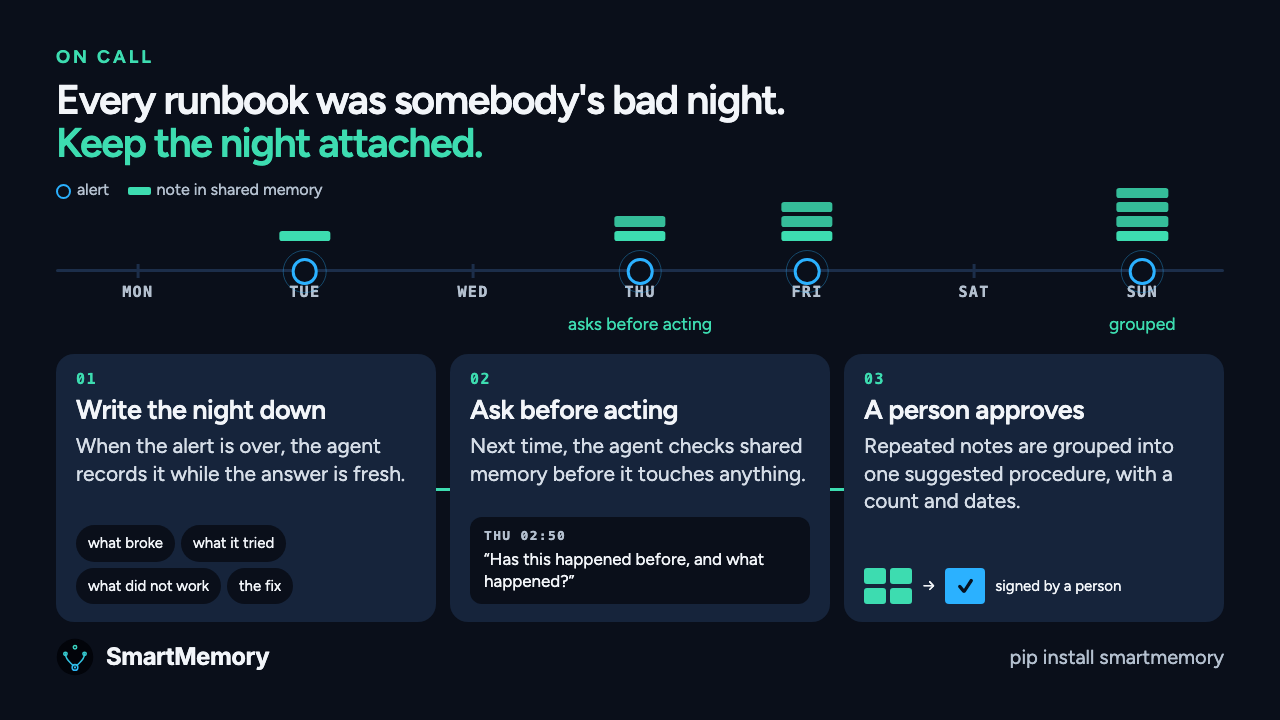
One week on call, run twice
Read the transcript
One team. One service. One alert that goes off four times in the same week. The alert is named after the database, so the dashboards they check all point there. The database is not the problem. Four people work that out separately, each in the middle of the night, each for the first time.
A handful of engineers taking turns with the pager, the on-duty phone that goes off when the service breaks. And a page on the company wiki they call the runbook, the how-to for when this goes wrong. Now put an AI agent on that rotation, taking the first look at each alert. By the end of this you will be able to show someone exactly why this team stopped restarting the database, and where that answer came from. Because here is the part nobody tells you. What one night's responder works out, the next one does not have.
And the written record ages while nobody watches.
Tuesday, three in the morning. Whoever answers the phone restarts the database. It holds for forty minutes. Thursday. Same alert, different person, same restart. Nobody knows Tuesday happened, because Tuesday happened to somebody else.
The runbook is a wiki page last edited eight months ago, whose first step opens a screen that no longer exists. Sunday, somebody answers the phone and asks the obvious question. Has this happened before. They get a shrug, a wiki page, and a link to a chat thread.
Run the same week again with one change. The team gets a shared notebook. The agent on that rotation reads it and writes to it, the people can too, and it outlives the night. The only moment anyone knows the answer is the moment nobody wants to type, so the thing that is already awake does the typing. Tuesday, three in the morning. The agent works the alert, and when it is over it writes down what went wrong, what it was doing, what it tried that did not work, and what it recorded as the fix.
That third one is what a tidy write-up loses, and the one the next person needs. Thursday, ten to three. Same alert. Before touching anything, the agent asks the notebook one question. Has this happened before, and what happened. Back come the notes that match, carrying whatever was filled in on the night.
So it skips the thing that looks right and goes to the thing that worked. The limit is real. The match runs on the name the trouble was filed under, and on how closely the description reads against the old ones. File it under a different name and Tuesday's note does not come back. A recorded fix is history, not a promise. The agent tries it and it holds.
The alert goes off twice more that week. By Sunday there are four notes saying much the same thing. So the notes get grouped, and the grouping hands back one suggestion, with a count and the dates of the first and last night. It does not write your runbook. A person reads it and the four nights underneath, then writes the procedure and approves it. The four notes stay where they are.
Here is the quiet part. The old wiki had forty runbooks and no way of knowing which three were any good. In this notebook, opening an entry is what counts in its favour, when the credit lands. Being offered does not count. Reading is the vote. So the pages the team uses come forward and the ones nobody opens go quiet.
Eight months ago somebody who has since left wrote one sentence worth more than the whole wiki. Do not restart the main database before the backup has finished taking over. On most teams it would sit in a document nobody opens. Here it sits with the team's own written rules, and underneath it, in plain words, what the risky move looks like. At the start of a shift, the agent asks for that list and reads it. The list does not stop anybody.
It gets put in front of whoever is about to act, rather than turning up at the meeting afterwards. The claim is not that it was prevented. It is that the sentence was still reachable, from somebody who left.
Monday morning. Somebody new answers the phone, and has not seen this alert before. They ask what Sunday's responder asked. Has this happened before. This time the answer is not a shrug. The procedure a person approved on Sunday comes back among the ranked answers.
Then the team's own software follows the four references it carries and fetches each night separately, with what went wrong, what was tried, what did not work, and when. Later that morning, at the incident review. Why did we stop restarting the database. The answer is on the record, and it does not depend on who is still on the team when the question gets asked. Be honest about what that proves. What was tried, what was written down, when.
Not that the fix was right. It is a claim a tired person made at three in the morning, not a verdict. Every runbook you have trusted was somebody's bad night. This one still has the night attached.
Nothing about this team got smarter. Thursday asked, Tuesday's note came back, the recorded fix held. That is what SmartMemory is. A memory your on-call agents share, that outlives the shift, the thread, and the goodbye. If you want to see what gets written at three in the morning, and what comes back on Thursday, that is Part 2. This was the week the person answering stopped starting from scratch.
The answer existed. It was in someone else's night.
What one night's responder works out, the next one does not have.
An alert goes off on Tuesday at three in the morning. Whoever has the pager restarts the database. It holds for forty minutes.
On Thursday the same alert fires, and a different person does the same restart. Nobody knows Tuesday happened, because Tuesday happened to somebody else. The runbook is a wiki page last edited eight months ago.
Nobody here is careless. What one night's responder works out, the next one does not have. And the only moment anyone knows the answer is the moment nobody wants to type.
How it works on call
- Step 1
Connect the agent
Point the AI agent on your rotation at one hosted MCP address, or write to memory from your own tooling over the REST API.
MCP server · hosted URL - Step 2
It writes down the night
When the alert is over, the agent records what went wrong, what it was doing, what it tried that did not work, and what fixed it. The part a tidy write-up loses is the part it keeps.
memory_log_failure - Step 3
The next night asks first
Before touching anything, the agent asks: has this happened before? The matching notes come back. When the same trouble repeats, a person reads the notes and approves a procedure.
memory_check_failure
One alert, asked twice
On-call agent, Thursday 02:50The database latency alert is firing again. Has this happened before?
Yes, Tuesday and Thursday. Restarting the database held about forty minutes both times. Your team's rule says: do not restart the main database before the backup has finished taking over. Tuesday's note has the recorded fix.
- Tuesday, 03:00
- Restarted the database. It held about forty minutes.
- Recorded fix
- Let the backup finish taking over, then reconnect the app.
- Team rule
- Do not restart the main database before the backup has finished taking over.
Tested, with the method shown
25 of 25
Right about past decisions
A notes file edited in place got 1 to 3. Synthetic questions, two seeds, two models.
Every change is kept, with its history
Decisions are never silently overwritten. One call shows where a memory came from, what it replaced, and whether its history checks out.
Questions on-call teams ask
Does it write our runbook?
No. When notes repeat, they can be grouped into one suggestion, with a count and the dates of the first and last night. A person reads it, writes the procedure and approves it.
What if the incident is filed under a different name?
Then the old note may not come back. The match runs on the name the trouble was filed under and on how closely the description reads. That limit is real.
Does a recorded fix mean it is right?
No. It is history, not a promise: what a tired person wrote down at three in the morning. The agent tries it and you see whether it holds.
What happens when someone leaves?
What they wrote stays reachable. The answer does not depend on who is still on the team.
Which notes come forward?
The ones people open. Being shown does not count, reading does. Notes nobody opens go quiet. Nothing is deleted.
Keep the night attached.
Every runbook you trusted was somebody's bad night. Install it in two commands.
pip install smartmemory && smartmemory setupOther teams, other weeks
- CodingYour codebase records what got built, not what got rejected
- AgentsYour AI agents never tell each other what they learned
- SupportCustomer context is not the same as remembering
- SalesThe one thing you need before the next call is not in your notes
- ComplianceEleven months later, somebody asks you to show why
- HealthcareFour clinicians, one chart, one missing sentence
- FinanceWhy does the desk own this? Nobody can say.
- LegalYour firm already answered this, last year, in another file
- RoboticsA robot stopped in aisle nine. The same fault happened ten days ago.