
Healthcare
Four clinicians, one chart, one missing sentence
Everyone was allowed to see the chart, and the sentence that mattered was summarised away. SmartMemory gives your clinic's software a shared record with required boxes. With the check on, a record missing one is refused.
pip install smartmemory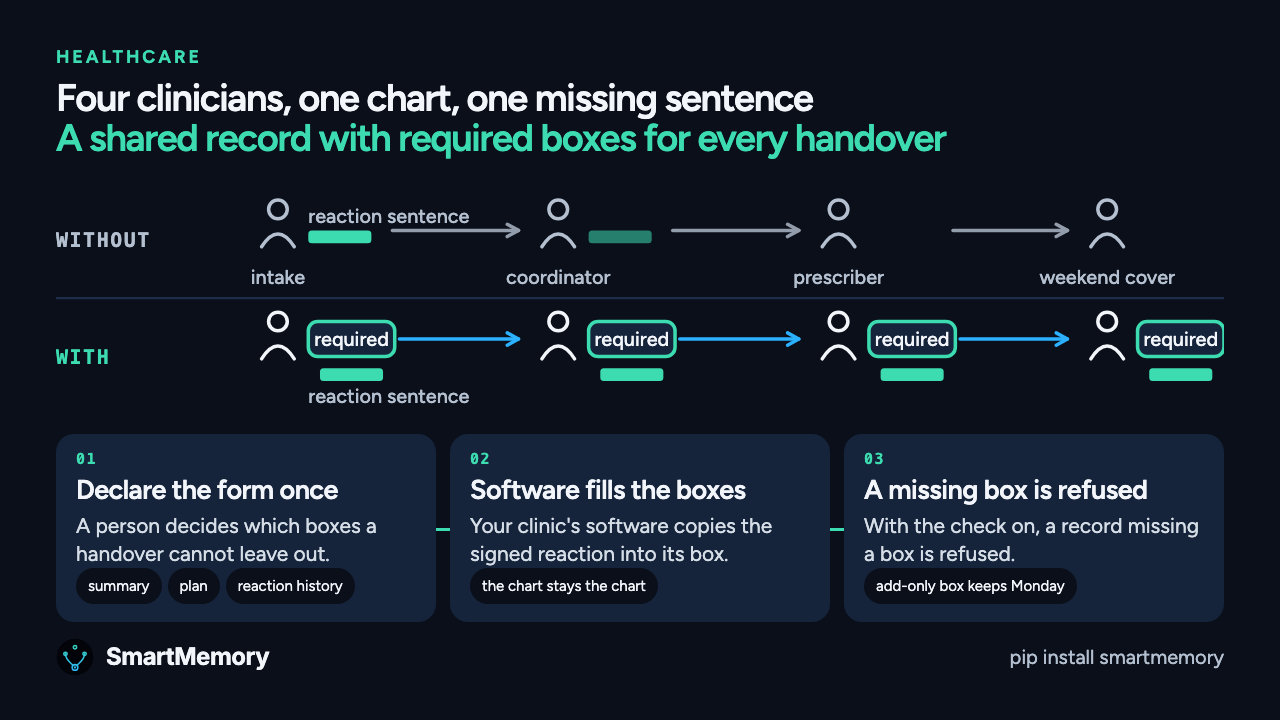
One clinic, one week, run twice
Read the transcript
One clinic. One week. Four roles, and not one of them is careless. All four are allowed to see the same chart. Nothing is hidden, nothing is locked. And on Saturday, the sentence that mattered most about this patient is not in front of the person who needs it.
Nothing was lost. It was summarised.
Meet the week. Intake sees the patient on Monday and writes the note. The prescriber acts on it Wednesday. A weekend cover comes in Saturday, looking after people they have never met. A coordinator keeps the week joined up. A clinic is built this way because care outlasts any one shift, so every week is a chain of handovers.
We will call the patient Patient R. There is one fact about them here. A documented severe reaction to something we will just call Antibiotic Family A. We never say what it means.
Monday. Intake does the job properly. Four paragraphs of careful writing, and in the middle of the second one is the sentence about Family A. Wednesday. The prescriber has eleven minutes and the chart has four pages, so something summarises it. Every line in that summary is true.
It is also incomplete, because the sentence about Family A is not in it. Saturday. The weekend cover reads the summary, because that is what a summary is for. Nobody did anything wrong, and here is why. A paragraph cannot have a required box. Everything in it is optional, so a sentence about a severe reaction is as easy to drop as a sentence about where to park.
Run the same week again, with one change made before Monday. The clinic gets a shared record that every step reads and writes. Not a blank sheet. A form. A form has boxes, the boxes have names, and a few carry that little asterisk that means you are not leaving until that box has something in it. Somebody writes out, once, what a visit here has to contain.
A summary. A plan. A signed reaction history. A follow up. Three of those are not optional. The chart is still the chart.
The clinic's own software carries the value across, and the shared record does not reach into the chart by itself. Wednesday, four o'clock, three people waiting. The write goes in with the reaction history simply not there. Not falsified, just missing. And it is refused, with the name of the missing box handed straight back. Now the small print.
Required means the box is there and holds the right kind of thing. Not full, not correct. Somebody still has to put the right value in it. And the refusal can be turned down to a warning by somebody who deliberately does that. Then Friday. Somebody adds to the reaction history.
They can add new lines all day, but with the check on, they cannot lift Monday's line off the top, because that box was drawn as one you only add to. It is a log of what was signed and when, not a claim about what is true today. A later correction is a new signed line, plus a change in the chart's current view, which clinicians go on correcting there.
Saturday again. The weekend cover opens the handover view, and the line about Family A is there, dated Monday. There is no magic in it. On Monday the software copied the signed entry into that box, because with the check on, the record is refused without it. On Friday nothing could lift it back off, because with the check on, that box only grows. On Saturday the software read the accepted record out into the view.
This is not software smarter than your staff. One repeatable check moved into the place where records get written, and your people still own the value, the workflow and the judgement.
The following Tuesday. Was this changed, and when? Ask about the visit record itself, and the honest answer is that no change history is kept for that one. Ask about Saturday's change of conclusion, and there is a trail. The belief held before, the belief held after, each one stamped, and each stamp folded into the next. The checking happens where the record lives, and what comes back is the result and a short preview to read.
Not the thing itself, so this is not something you re-check yourself. If a line was changed and the stamps were not all redone to agree, the walk stops and tells you where. Somebody who rewrites the whole history and redoes every stamp is a different problem, and catching that needs a copy kept where this database cannot reach it. We are not showing you one. So this is narrow. It does not prove anybody was right.
What it means is that the answer comes off the record, and does not depend on who is still at the clinic when the question gets asked.
Nothing in that week was clever. Nobody was notified. Nothing watched anybody, and no part of this had an opinion about medicine. The chart is still the chart, and the clinician still signs it. The one change is that a person, not the software, said in advance which boxes a handover cannot leave out. That is what SmartMemory is.
A shared record your software writes into, that with the check on refuses a record missing a box somebody declared, and that check can be deliberately turned down to a warning. If you want to see how that form gets described, and what those answers really say, that is Part 2. A paragraph will accept anything. A form has an asterisk, and the asterisk is the whole difference.
Nothing was lost. It was summarised.
A paragraph will accept anything. A form has an asterisk, and the asterisk is the whole difference.
Intake sees the patient on Monday and writes four careful paragraphs. In the middle of the second is the sentence about a documented severe reaction. On Wednesday the prescriber has eleven minutes and the chart has four pages, so something summarises it.
Every line in the summary is true. It is also incomplete, because the sentence about the reaction is not in it. On Saturday the weekend cover, who has never met this patient, reads the summary, because that is what a summary is for.
Nobody did anything wrong. A paragraph cannot have a required box. Everything in it is optional, so a sentence about a severe reaction is as easy to drop as a sentence about where to park.
How it works in a clinic
- Step 1
Declare the form once.
Somebody at the clinic writes out, once, what a visit record has to contain: a summary, a plan, a signed reaction history and a follow up. Three of those are not optional. A person, not the software, decides in advance which boxes a handover cannot leave out.
- summary
- plan
- reaction history
- Step 2
Your clinic's software fills the boxes.
It copies the signed reaction entry out of the chart into the box, and reads the accepted record into the handover view. The chart is still the chart, and the shared record does not reach into it by itself.
- the chart stays the chart
- Step 3
A record missing a box is refused.
If a write arrives without the reaction history, then with the check on it is refused and the name of the missing box comes back. A box drawn as add-only takes new lines all day but cannot lose Monday's line.
- add-only box keeps Monday
Saturday, the handover view
You (weekend cover, Saturday)I have never met this patient. What must I know before I act?
The signed reaction history is the first thing on the record: a documented severe reaction, dated Monday. Your clinic's software copied it in on Monday, and with the check on a record without it is refused.
- Monday
- the signed entry is copied from the chart into the reaction history box.
- Friday
- new lines can be added, Monday's line cannot be lifted off.
- Saturday
- the handover view reads the accepted record.
Tested, with the method shown
Every change is kept, with its history
Decisions are never silently overwritten. One call shows where a memory came from, what it replaced, and whether its history checks out.
25 of 25
Right about past decisions
A notes file edited in place got 1 to 3. Synthetic questions, two seeds, two models.
Questions clinics ask
Does it make clinical decisions or watch patients?
No. Nobody was notified, nothing watched anybody, and no part of it has an opinion about medicine.
Does "required" mean correct?
No. Required means the box is there and holds the right kind of thing. Not full, not correct. Somebody still has to put the right value in it.
Can the refusal be turned off?
It can be turned down to a warning by somebody who deliberately does that.
Is the shared record the chart?
No. The chart is still the chart and the clinician still signs it. The record is a log of what was signed and when, not a claim about what is true today. A later correction is a new signed line, plus a change in the chart's current view.
Can I prove nobody changed it?
Only narrowly. If a line was changed and the stamps were not all redone to agree, the check stops and says where. Somebody who rewrites the whole history and redoes every stamp is a different problem, and it does not prove anybody was right.
Put the asterisk in.
A paragraph will accept anything. Say in advance which boxes a handover cannot leave out.
pip install smartmemoryOther teams, other weeks
- On callFour engineers solved the same outage four times in one week
- CodingYour codebase records what got built, not what got rejected
- AgentsYour AI agents never tell each other what they learned
- SupportCustomer context is not the same as remembering
- SalesThe one thing you need before the next call is not in your notes
- ComplianceEleven months later, somebody asks you to show why
- FinanceWhy does the desk own this? Nobody can say.
- LegalYour firm already answered this, last year, in another file
- RoboticsA robot stopped in aisle nine. The same fault happened ten days ago.