
Legal
Your firm already answered this, last year, in another file
The answer was in the building, in a matter for a different client. SmartMemory lets a search walk from one document to the next through the names they share.
pip install smartmemory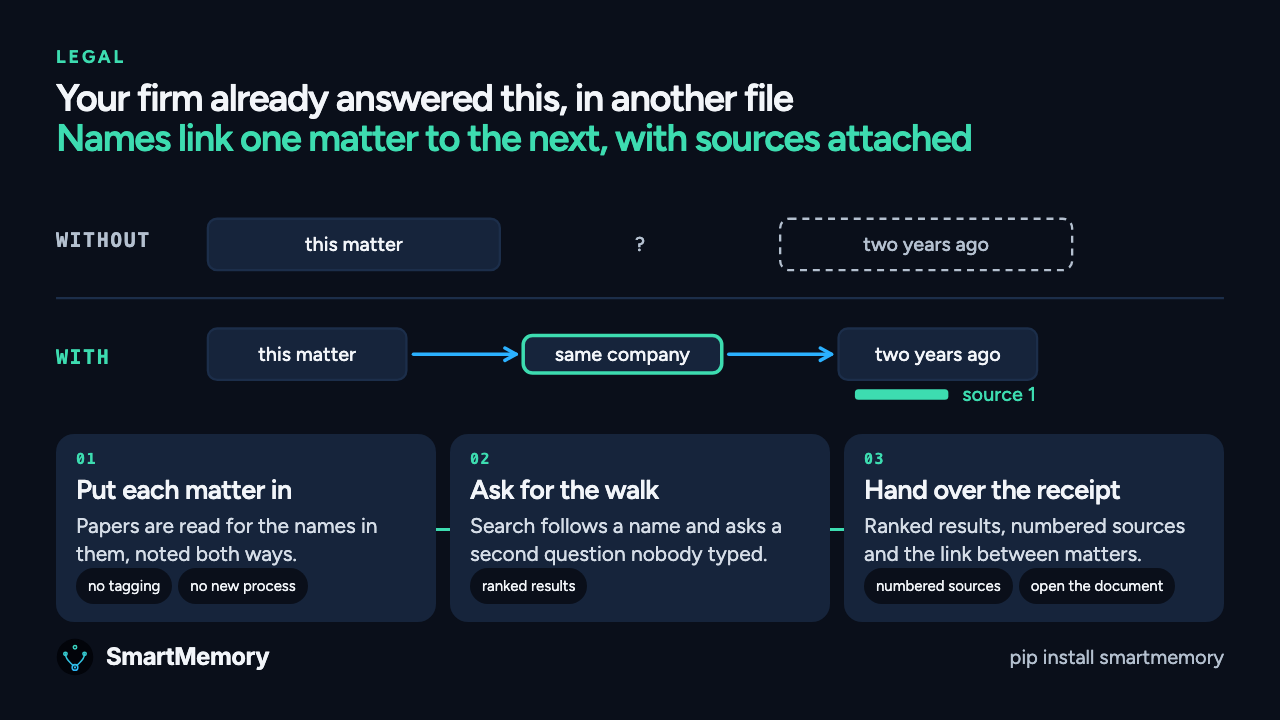
One firm, one week, run twice
Read the transcript
Nothing in this week went missing, nothing was deleted, nobody was careless. This is not a story about a firm that forgot. It is about a firm with the answer in the building and no way to reach it.
Four roles, one firm, one week. Someone opens the matter. Someone does the research. Someone senior signs what goes out. Someone keeps the running record of what happened and when. And that is the problem.
Everything is filed by matter, one file per piece of work, and the answer to today's question is usually in somebody else's. By the end you can hand another lawyer an answer, the sources it came from, and a connection between two matters nobody had written down.
Tuesday morning. The senior lawyer asks a short question. Have we ever taken a position on a clause like this one? The researcher searches the firm's document store for the wording. Four hundred results, so the search is narrowed to this client. Two results, both from this matter, both written last week.
Precise, and wrong. The real answer is in a matter from two years ago, for a different client, where a lawyer who has since left wrote two paragraphs that land exactly on the question. One this researcher is allowed to read. The document store did nothing wrong. It answered the question it was asked. The only thing joining the two matters is one company that turns up in both.
Once each, in the small print at the top. They did not lose it. They had no way to walk to it. To find it you would have to already know it was there, which is what you were asking.
Run the same week again. Nobody adopts a new process, nobody tags anything. As each matter's papers go into the store, they are read for the names in them, and what that reading turns up gets noted both ways. Which names are in this document, and which documents this name is in. Instead of a shelf of folders, a wall with string on it. Tuesday again, same question.
This time the search does not stop at its first answer. It reads its own best results, picks a name it has not chased yet, and asks a second question nobody typed. It asks about that company, and lands on the matter from two years ago. Then it follows the wording of the clause out of that matter to the two paragraphs. One question was asked out loud. Two more were written along the way, and those were the ones that mattered.
The search has two settings for how brave it is about which name to chase. The careful one wants a name that stands out from the other names around it. On this Tuesday the company is named once, in the small print, among many others. So it decides the name is not worth chasing, and stops after the first answer. No error, no warning. Just a list that looks reasonable and does not have the answer in it.
So somebody has to ask for the braver one. Nothing sat watching these two matters and noticed they were related. Nothing swept, nothing scheduled. A person asked, in a particular way, at the moment they asked.
Something else changed quietly. Every matter has a running record of what happened and when, and here each line of it is written as its own separate entry. Which sounds like nothing, until a fact turns up late. A letter from last March that nobody had slides into the middle of the record where it belongs, and nothing underneath gets renumbered or re-dated. And if the same notice genuinely went out twice, word for word, both stay on the record. The store will write the same line twice if asked twice, so the firm's own software checks what it already holds, and writes these as the first and the second time.
A record that quietly merges two events has edited the history it exists to keep.
Friday. The senior lawyer asks the question every manager asks eventually. Can we stand behind Tuesday's answer? The firm's own software puts a receipt together, out of three separate lookups it lines up side by side. First, the results, ranked, most of them carrying how far from the question they were found. Later finds are weighted down in that ranking, with one deliberate exception.
Second, a numbered set of sources, each with a short extract and a way for a reviewer with access to open the real document. The extract is not the document. Third, the connection between where the question started and where the answer was found, if there is one to find. If there is none, none comes back. One caveat. That connection is not a recording of the route the search took.
It is a separate look at how the two ends are joined. And notice what the answer does not rest on. Not on the lawyer who wrote those paragraphs still being at the firm.
Nothing about this firm got better at its job this week. What changed is that it could walk from one thing it knew to another, without already knowing which folder to open. That is what SmartMemory is. A memory your systems share, so an answer in somebody else's matter is reachable from the question you asked. It does not claim to have found everything. It found this one, and it can hand over what connects it.
If you want to see how the walk works, where it stops, and what that receipt looks like, that is Part 2. This was the week the answer stopped hiding in plain sight.
They did not lose it. They had no way to walk to it.
This is not a story about a firm that forgot. It is about a firm with the answer in the building and no way to reach it.
On Tuesday morning the senior lawyer asks a short question: have we ever taken a position on a clause like this one? The researcher searches the firm's document store. Four hundred results, so the search is narrowed to this client. Two results, both from this matter, both written last week. Precise, and wrong.
The real answer is in a matter from two years ago, for a different client, where a lawyer who has since left wrote two paragraphs that land exactly on the question. The document store did nothing wrong. It answered the question it was asked.
The only thing joining the two matters is one company that turns up in both, once each, in the small print at the top. To find the answer you would have to already know it was there, which is what you were asking.
How it works for a firm
- Step 1
Put each matter's papers in.
As each matter's papers go into the store, they are read for the names in them. What that reading finds is noted both ways: which names are in this document, and which documents this name is in. Nobody adopts a new process and nobody tags anything.
- no tagging
- no new process
- Step 2
Ask for the walk.
A person asks for a search that follows names. It reads its own best results, picks a name it has not chased yet and asks a second question nobody typed. In the film that lands on the matter from two years ago, and a third question follows the clause out to the two paragraphs.
- ranked results
- Step 3
Hand over the receipt.
The firm's own software lines up three lookups: the ranked results, a numbered set of sources each with a short extract and a way for a reviewer with access to open the real document, and the connection between where the question started and where the answer was found, if there is one.
- numbered sources
- open the document
Friday, can we stand behind Tuesday's answer?
You (senior lawyer)Can we stand behind Tuesday's answer?
Here is the receipt. The answer is two paragraphs in a matter from two years ago, found by following the company that appears in both matters. Each source is numbered, with a short extract and a way to open the real document if you have access. The extract is not the document.
- Results
- ranked, most of them carrying how far from the question they were found.
- Sources
- a numbered set, each with a short extract.
- Connection
- how the two ends are joined, if there is one to find.
Tested, with the method shown
25 of 25
Right about past decisions
A notes file edited in place got 1 to 3. Synthetic questions, two seeds, two models.
Every change is kept, with its history
Decisions are never silently overwritten. One call shows where a memory came from, what it replaced, and whether its history checks out.
Questions law firms ask
Does it get around who may read what?
No. The answer was in a matter the researcher was already allowed to read. That boundary is the one thing nothing here moves.
Does it watch our matters and flag related ones?
No. Nothing sat watching, nothing swept and nothing was scheduled. Every walk is a search a person ran, in a particular way, at the moment they asked.
Does it find everything?
No. It does not claim to have found everything. It found this one, and it can hand over what connects it.
What if the careful setting misses it?
The careful setting wants a name that stands out among the names around it. A company named once, in the small print, can fail that test, and the search stops after the first answer with no error and no warning. Somebody has to ask for the braver setting.
Is the connection a recording of the search?
No. It is a separate look at how the two ends are joined, not a recording of the route the search took.
Walk to the answer.
A memory your systems share, so an answer in somebody else's matter is reachable from the question you asked.
pip install smartmemoryOther teams, other weeks
- On callFour engineers solved the same outage four times in one week
- CodingYour codebase records what got built, not what got rejected
- AgentsYour AI agents never tell each other what they learned
- SupportCustomer context is not the same as remembering
- SalesThe one thing you need before the next call is not in your notes
- ComplianceEleven months later, somebody asks you to show why
- HealthcareFour clinicians, one chart, one missing sentence
- FinanceWhy does the desk own this? Nobody can say.
- RoboticsA robot stopped in aisle nine. The same fault happened ten days ago.