
Robotics
A robot stopped in aisle nine. The same fault happened ten days ago.
Memory links the new note to the earlier fault, so the technician and the robot both start from what the team already did. SmartMemory gives your fleet one shared memory for notes, decisions and procedures.
pip install smartmemory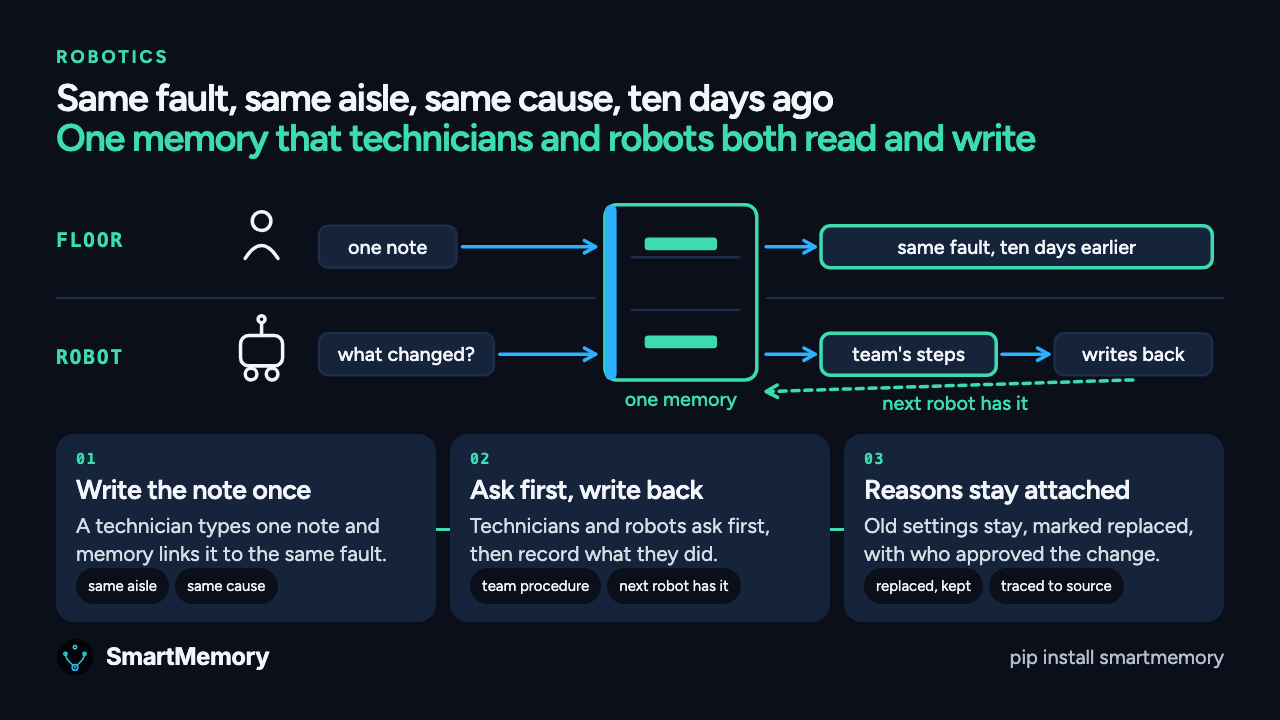
One fault, from the floor to the robot
Read the transcript
Kestrel Robotics runs a fleet of warehouse robots. Their notes, decisions and procedures all live in one shared memory.
A new incident comes in from the floor. A robot stopped in aisle nine with a fault. The technician types one note, once, and memory takes it from there.
Has this fault happened before? Yes. Memory links the new note to the same fault ten days earlier, same aisle, same cause. Nobody had to remember it.
A technician asks how to recover a stalled unit. They get the team's own procedure, step by step, along with the past stall it came from.
Now the robots themselves. At power-on, a unit asks memory what changed since its last shift. On a fault, it checks the earlier incidents and follows the team's steps. Then it writes back what it did, and the next robot already has it.
Why did we lower the gripper torque? The answer comes with the reason, and it shows the old setting it replaced.
Every decision keeps its reasons, the options the team turned down, and who approved it. The old decision is still there, marked as replaced.
And you can trace any answer back to where it came from. No guessing, and no digging through old chat threads.
Robots that remember. SmartMemory.
The answer existed. It was ten days old.
Nobody had to remember it.
A robot stops in aisle nine with a fault. The technician writes up what they see. The fleet in the film is invented, a warehouse company called Kestrel Robotics, and the incident is made up.
Ten days earlier, the same fault stopped a robot in the same aisle, for the same cause. Someone would have to remember that it happened, and where its notes went.
Nobody here is careless. The notes, decisions and procedures exist. What is hard is having the right one in front of you at the moment of the fault.
How it works for a robot fleet
- Step 1
Write it down once.
The technician types one note about the incident, once, and memory takes it from there. It links the new note to the same fault ten days earlier, same aisle, same cause.
- same aisle
- same cause
- Step 2
Technicians and robots ask first.
A technician asks how to recover a stalled unit and gets the team's own procedure, step by step, along with the past stall it came from. The robots ask too. At power-on a unit asks memory what changed since its last shift. On a fault it checks the earlier incidents and follows the team's steps. Then it writes back what it did, and the next robot already has it.
- team procedure
- next robot has it
- Step 3
Every answer keeps its reasons.
Ask why the team lowered the gripper torque and the answer comes with the reason, and the old setting it replaced. Every decision keeps its reasons, the options the team turned down, and who approved it. The old decision stays, marked as replaced.
- replaced, kept
- traced to source
Two questions, asked at the fault
YouHas this fault happened before? How do I recover a stalled unit?
Yes. The same fault, ten days earlier, in the same aisle, with the same cause. Here is the team's own procedure, step by step: press the amber hold button on the arm panel, note the fault code and unit number, clear the aisle and tow the unit to the service bay, restart the arm controller, run the ten-pick self-test, and only then return it to the fleet. The past stall it came from is listed beside it.
- Earlier fault
- ten days ago, same aisle, same cause.
- Procedure
- the team's own, step by step.
- Source
- the past stall it came from.
Tested, with the method shown
25 of 25
Right about past decisions
A notes file edited in place got 1 to 3. Synthetic questions, two seeds, two models.
Every change is kept, with its history
Decisions are never silently overwritten. One call shows where a memory came from, what it replaced, and whether its history checks out.
Questions robot teams ask
Do the robots really use it?
In the film the robot side is shown as a log in a terminal, two units named K-07 and K-11, not as physical robots. What the log shows is the unit asking memory what changed since its last shift, checking the earlier incidents on a fault, following the team's steps and writing back what it did.
Does a recorded fix mean it is right?
No. It is what the team wrote down. The procedure comes back with the past stall it came from, so a person can read where it started and judge it.
What happens when someone changes a decision?
The old decision is still there, marked as replaced. Every decision keeps its reasons, the options the team turned down, and who approved it.
Where did an answer come from?
You can trace any answer back to where it came from. No guessing, and no digging through old chat threads.
Is the fleet in the film real?
No. Kestrel Robotics is an invented warehouse fleet, and the faults, aisles and people on screen are made up for the film.
Robots that remember.
Notes, decisions and procedures in one shared memory, for the technician and the robot alike. Start with one command.
pip install smartmemoryOther teams, other weeks
- On callFour engineers solved the same outage four times in one week
- CodingYour codebase records what got built, not what got rejected
- AgentsYour AI agents never tell each other what they learned
- SupportCustomer context is not the same as remembering
- SalesThe one thing you need before the next call is not in your notes
- ComplianceEleven months later, somebody asks you to show why
- HealthcareFour clinicians, one chart, one missing sentence
- FinanceWhy does the desk own this? Nobody can say.
- LegalYour firm already answered this, last year, in another file