
Sales
The one thing you need before the next call is not in your notes
Security raised a question on Monday and your engineer heard it as new on Wednesday. SmartMemory puts the week's calls on one board that stays after the person who heard them moves on.
pip install smartmemory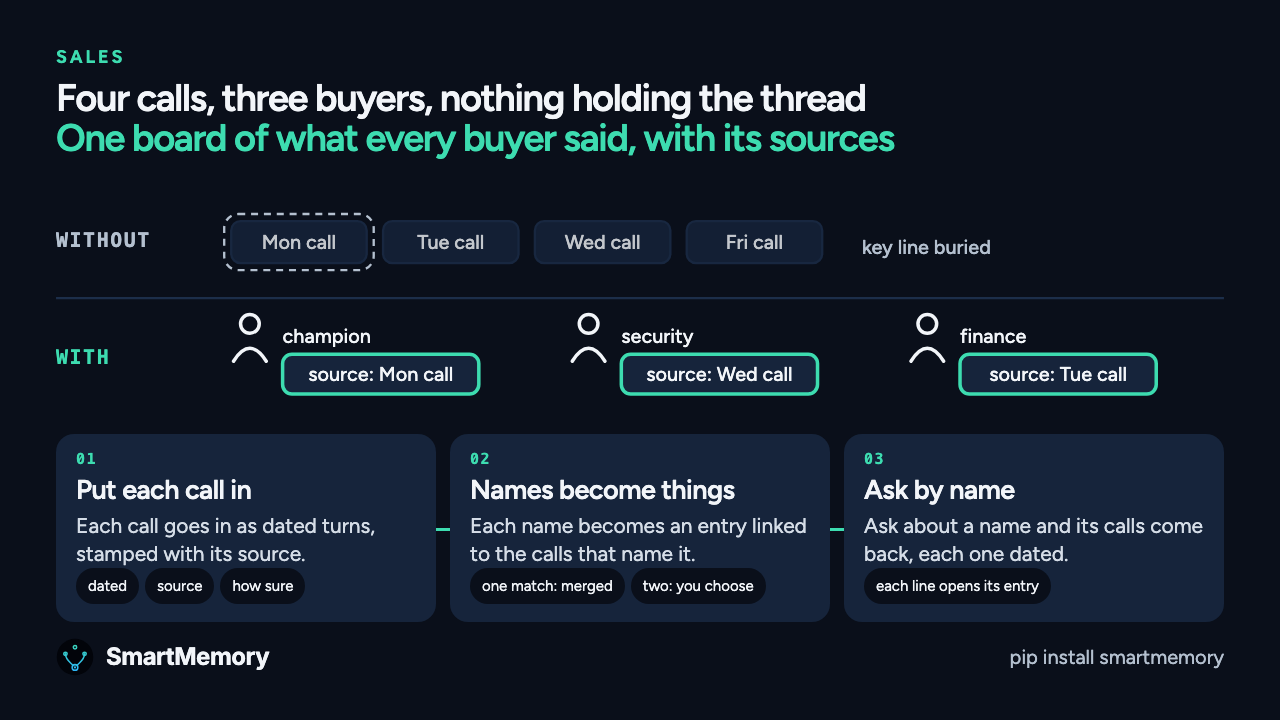
One deal, four calls, run twice
Read the transcript
Four calls in one week. Three people on the other side. One deal. By Friday your notes hold every word of all four. And the one thing you need before the next call is not written down anywhere, because nobody was ever going to write it down.
The cast is small. On your side, a rep and a sales engineer. On theirs, three people. A champion who wants this. A security lead with questions. A finance lead who signs.
Nobody over there can say yes on their own, so it gets decided a piece at a time, across four calls.
Monday. Discovery goes well, and the champion mentions that their security lead will want to talk about how signing in will work with their systems. It goes in the notes. Tuesday. Pricing, with the finance lead. A different call, a different document, no reason to open Monday's notes.
Wednesday. The engineer meets the security lead, who asks how signing in would work with their systems. Monday's line never came forward, so the engineer hears it as new. Thursday. Finance has stopped asking how much and started asking when, and the security lead has taken the question to their own team. Friday, one hour before the call that matters.
The record is in good order, all four calls there with an accurate summary. But the rep's question is not about one call. It is what security and finance raised across all four, and what moved this week. Four correct answers, one per call, and nothing holding the thread between them. And a smaller problem hides inside it. On Monday the rep wrote the product's name out in full.
Payments Vault. On Wednesday the engineer typed Vault. Two names for one thing, and looking for one does not turn up the other. Nobody here was sloppy. The week was written down correctly four times.
Now run the same week again. The rep does nothing differently. The difference is a shared notebook. The week's calls go onto it as a board of people and things, with each call attached to the names that came up in it. Then one sweep goes over that board looking for the same thing written two ways, and folds Vault into Payments Vault. It only does that when exactly one longer name could contain the short one.
Put a Secrets Vault up there and Vault could be either, so it hands you both rather than guess. Friday, one hour out. The rep asks the board about Payments Vault by name. Back comes Monday's call, which used both words. And back comes Wednesday's call, where the engineer only typed the short word. The word Payments is nowhere in what they said, so looking for it in the text goes straight past.
It comes back because it hangs off that name. So Monday's line reaches whoever is prepping Friday's call, from a conversation they were not on. One more thing is on the board. Three items this week ended up attached to the security lead's name, and when three or more hang off one name, a tidy-up step usually writes one short summary of them, and failing that joins those notes together instead. Nothing worked out that the security lead is the important one. It counted, and three is a number somebody chose and can change.
That step does not start on its own, it runs when it is asked to, and what it writes is filed where the ordinary search does not look, so you have to ask for it.
Now the part every manager has lived through. The rep who ran Monday's call comes off the deal. In the first week, Monday's insight left with them. In the second week it does not leave, because it was never only in their head. It went onto the board, and the board belongs to the team, not to the person who typed it. Somebody new with access can ask by the same name and reach the same stored notes.
The insight is not sitting in one person's head any more. The answer does not depend on who is still on the deal when the question gets asked.
Friday morning. Same hour, same question. What do we know about this account. Your own tooling asks the board and builds a short card out of what comes back. It asks the way that reaches the summary, and if the summary comes back it goes to the front. Two lines about the security lead.
One about the finance lead. One about the thing that changed between Tuesday and Thursday. Nothing noticed that change. Both calls are dated, and the card puts the dates side by side. Then the manager asks where that came from. The card opens the stored entries underneath it, each one dated.
And if one cannot be found, it says so rather than filling the gap. Notice what is not on that card. No suggested next step, no talk track, no score on the deal. A card nobody can check is two sentences you have to take on trust. This one comes with its sources attached, so you can open the one that surprises you before you repeat it to a customer.
Nobody got better at selling this week. Your system of record is still your system of record, and nothing was updated on your behalf. What changed is that things said in four separate rooms ended up on one board, and stayed there after the person who heard them moved on. That is what SmartMemory is. Your notes remember the meeting. This remembers the person you had it with.
If you want to see how the board actually works, that is Part 2.
Four correct answers, and nothing holding the thread.
Four correct answers, one per call, and nothing holding the thread between them.
A rep and a sales engineer work a deal with three people on the other side: a champion who wants it, a security lead with questions and a finance lead who signs. Nobody there can say yes on their own, so it is decided a piece at a time across four calls.
On Monday the champion mentions that security will want to talk about how signing in works with their systems, and it goes in the notes. On Wednesday the engineer meets the security lead, who asks. Monday's line never came forward, so the engineer hears it as new.
On Friday, one hour before the call that matters, the record is in good order. But the question is what security and finance raised across all four calls, and what moved this week. Nobody was sloppy. The week was written down correctly four times.
How it works for a sales team
- Step 1
Put each call in as dated turns.
Turning a call into text is somebody else's job, and SmartMemory starts when the text exists. Each call goes in as a run of turns in order, with a date on the front, and your application stamps each item with what it is, where it came from and how much you stand behind it.
- dated
- source
- how sure
- Step 2
Names become things on the board.
The names in each call become their own entries, linked to the calls that mention them. One pass folds "Vault" into "Payments Vault" only when exactly one longer name could contain it. When two could, it hands you both rather than guess.
- one match: merged
- two: you choose
- Step 3
Ask by name.
Before the next call, ask the board about Payments Vault by name. Monday's call comes back, and so does Wednesday's, where the engineer only typed the short word. Your tooling builds a short card from what comes back, and each line can open the stored entry behind it, dated.
- each line opens its entry
Friday, one hour before the call
You (rep)What do we know about this account?
Two lines on the security lead, one on the finance lead, and one on what changed between Tuesday and Thursday. Each line opens the stored entry it came from, dated.
- Security lead
- wants to talk about how signing in works with their systems (Monday, Wednesday).
- Finance lead
- stopped asking how much and started asking when (Thursday).
- What changed
- the security lead has taken the question to their own team (Thursday).
Tested, with the method shown
25 of 25
Right about past decisions
A notes file edited in place got 1 to 3. Synthetic questions, two seeds, two models.
Every change is kept, with its history
Decisions are never silently overwritten. One call shows where a memory came from, what it replaced, and whether its history checks out.
Questions sales teams ask
Does it replace our CRM?
No. Your system of record is still your system of record. Nothing was synced and nothing was updated on your behalf.
Does it tell the rep what to say, or score the deal?
No. There is no suggested next step, no talk track and no score on the card. A card nobody can check is two sentences you have to take on trust, so this one comes with its sources attached.
What if it cannot tell which name I mean?
It hands you both rather than guess.
Does it find everything?
No. It does not catch every name, and there is a cap on how many it pulls out of one stretch of text. Matching by name is one of the ways the search looks, merged by rank, and nothing promises this one wins.
What happens when the rep leaves the deal?
The insight does not leave with them, because it was never only in their head. It went onto the board, and the board belongs to the team. Somebody new with access can ask by the same name and reach the same stored notes.
Keep the thread.
Your notes remember the meeting. This remembers the person you had it with.
pip install smartmemoryOther teams, other weeks
- On callFour engineers solved the same outage four times in one week
- CodingYour codebase records what got built, not what got rejected
- AgentsYour AI agents never tell each other what they learned
- SupportCustomer context is not the same as remembering
- ComplianceEleven months later, somebody asks you to show why
- HealthcareFour clinicians, one chart, one missing sentence
- FinanceWhy does the desk own this? Nobody can say.
- LegalYour firm already answered this, last year, in another file
- RoboticsA robot stopped in aisle nine. The same fault happened ten days ago.