
Finance
Why does the desk own this? Nobody can say.
The desk bought a stake for two reasons, and by Friday nobody could name both. SmartMemory keeps the reason in one place, with pointers to what it was built on.
pip install smartmemory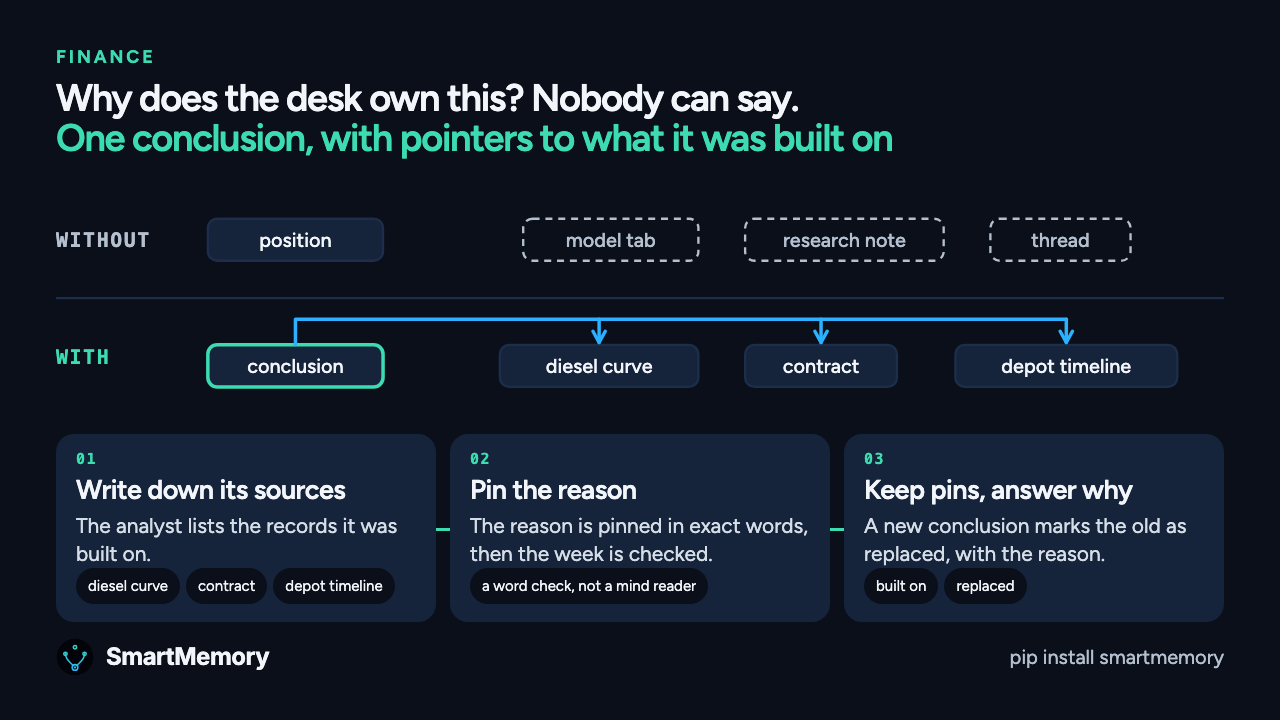
One position, one week, run twice
Read the transcript
Your team is putting AI agents to work alongside people. This one reads all day and drafts nearly everything, and between sessions it keeps nothing. The problem is not that your team fails to write things down. Any good desk does. It is that the reason gets written in three places, none of them attached to the thing it explains.
Meet the desk. Three people and an AI agent. One forms the view. One checks it, which means knowing why the desk owns what it owns. One decides what the desk holds. The agent reads all day and drafts.
It is split this way because nobody holds the stake, the reason for it, and the case against it at once. By the end you could show somebody weeks later what the desk concluded, what it was built on, and what replaced it.
Monday. The desk buys a stake in a logistics company, and the whole reason is two things staying true. Diesel costs keep coming down, and a new depot contract lands this quarter. Two things. Diesel and depot. And it does get written down.
A tab in the model. A paragraph in the research note. A message thread. None attached to the stake. The week does what weeks do. Tuesday, the diesel number comes in low, and the agent writes up the company's warehouse automation programme, because that is what turned up in its reading.
Wednesday, a competitor cuts prices. Nobody says the word depot again all week. Nobody decided it was wrong. Friday. Why are we still in this? The reviewer can pull up what is at risk and what happened this week.
The two-part reason is the thing nobody can pull up. It lives in three places attached to nothing. The analyst remembers diesel, which is half of it. The agent, which has read everything and kept nothing, says warehouse automation. Neither is it. Written down three times, linked zero times.
Now run the same week again with one change. The desk gets a shared notebook. The four of them read it and write in it, and it outlives the week. Monday. Same stake, same reason. This time the analyst writes the conclusion into the notebook in the words they meant, and lists the records it was built on.
The diesel curve, the contract announcement, the depot timeline. Those are pointers, so when the records they point at are there, the notebook walks from the conclusion to what it was built on. Somebody owns checking they are there. Then the analyst pins the reason to the board in the exact words, because on Thursday the week gets held up next to those words. Tuesday, the agent hands over the low diesel number and says this one supports the reason. Wednesday, it hands over the competitor's price cut and says this one argues against.
Somebody chose, both times.
Thursday afternoon, somebody runs a check. Somebody. It does not run itself, and nothing watches the desk's notes. A person hands in the week's work and chooses what counts. Are the pinned words still showing up? The pinned reason has six words worth checking.
Diesel, keeps, falling, depot, lands, quarter. The week says diesel back. It does not say the other five, and one of the five is depot. The desk just stopped saying it. That is the worst band, and the one case where the card gets marked. It now reads needs a second look, with the day somebody looked on it.
Not a siren, just a quiet line. This is a word check, not a mind reader. The desk pinned a second card. This position is not about warehouse automation. The week was full of warehouse automation, and that card came back looking fine, and nothing on it changed. A word check cannot read the word not.
Friday, and here is the part a budget owner notices. The week's pins do not get thrown away. They become standing entries the desk keeps, including the one that got marked. Nobody had decided those words should stop showing up. Each one points back at the pin it came from, where that link was made.
Six weeks later the desk sells out, and the hard question has an answer. Why did we close this? Somebody writes the new conclusion and marks the old one as replaced, with the reason on the link between them. Ask the notebook about the new conclusion and you get the conclusion, what it was built on, and the old conclusion it replaces. The substance is on that week-one page, with pointers to what supported the reason and what argued against it. Thursday's mark is still on the pin, recording the day somebody ran the check, not the day the word went quiet.
The answer most desks can give is a date and a feeling. This one can give a date, two words, a document, and the conclusion that replaced the old one. It does not depend on who is still around.
Nothing here decided whether the desk was right. That is not a thing it does, and anybody whose software claims otherwise is selling you something. The numbers still come in. The model still runs. A person still signs off. What changed is that the reason was written in one place, with pointers to what it was built on that somebody can check, and that once, on a Thursday, somebody held the week up against it.
That is what SmartMemory is. A shared memory your team writes in, that outlives the week, the handoff, and the goodbye. If you want to see what gets written and what the answers really look like, that is Part 2.
Written down three times, linked zero times.
Written down three times, linked zero times.
On Monday the desk buys a stake in a logistics company for two reasons: diesel costs keep coming down, and a new depot contract lands this quarter. It does get written down, in a tab in the model, a paragraph in the research note and a message thread. None of them is attached to the stake.
The week does what weeks do. The diesel number comes in low and the agent writes up the company's warehouse automation programme, because that is what turned up in its reading. A competitor cuts prices. Nobody says the word depot again all week, and nobody decided it was wrong.
On Friday somebody asks why the desk is still in this. The analyst remembers diesel, which is half of it. The agent, which has read everything and kept nothing, says warehouse automation. Neither is it.
How it works on a desk
- Step 1
Write the conclusion with what it was built on.
The analyst writes the conclusion in the words they meant and lists the records it was built on: the diesel curve, the contract announcement and the depot timeline. When those records are there, the notebook can walk from the conclusion to them. Somebody owns checking they are there.
- diesel curve
- contract
- depot timeline
- Step 2
Pin the reason, then check the week against it.
The analyst pins the reason in the exact words. On Thursday somebody hands in the week's work and runs the check. If the pinned words have stopped showing up, the card is marked "needs a second look" with the day somebody looked. It is a word check, not a mind reader.
- a word check, not a mind reader
- Step 3
Keep the pins, then answer why.
The week's pins become standing entries the desk keeps, each pointing back at its pin. Six weeks later the desk writes the new conclusion and marks the old one as replaced, with the reason on the link between them. One call returns the new decision, what it was built on and what it replaced.
- built on
- replaced
Six weeks later
You (PM)Why did we close this?
The desk closed it because one of the two things it needed stopped being mentioned. The new conclusion replaced the old one, with the reason on the link between them. The week-one record has the pointers to what supported the reason and what argued against it. The mark on the pinned reason shows the day somebody ran the check, not the day the word went quiet.
- Replaced
- the Monday conclusion, marked as replaced.
- Built on
- the diesel curve, the contract announcement, the depot timeline.
- Pinned reason
- marked "needs a second look" on Thursday of week one.
Tested, with the method shown
25 of 25
Right about past decisions
A notes file edited in place got 1 to 3. Synthetic questions, two seeds, two models.
Every change is kept, with its history
Decisions are never silently overwritten. One call shows where a memory came from, what it replaced, and whether its history checks out.
Questions finance teams ask
Does it decide whether the desk was right?
No. That is not a thing it does. The numbers still come in, the model still runs and a person still signs off.
Does it watch our notes for drift?
No. Somebody runs the check and hands in the week's work. It does not run itself, and nothing watches the desk's notes.
Can it catch a "not"?
No. A word check cannot read the word not. A card saying the position is not about warehouse automation came back looking fine in a week full of warehouse automation.
Does it say why the words stopped?
No. It detects that pinned words have stopped showing up and does not explain why.
Does it check that the records exist?
No. The notebook links to the records when their ids resolve, and somebody owns checking they are there.
Write the reason once.
Then "why did we close this?" has an answer that does not depend on who is still around.
pip install smartmemoryOther teams, other weeks
- On callFour engineers solved the same outage four times in one week
- CodingYour codebase records what got built, not what got rejected
- AgentsYour AI agents never tell each other what they learned
- SupportCustomer context is not the same as remembering
- SalesThe one thing you need before the next call is not in your notes
- ComplianceEleven months later, somebody asks you to show why
- HealthcareFour clinicians, one chart, one missing sentence
- LegalYour firm already answered this, last year, in another file
- RoboticsA robot stopped in aisle nine. The same fault happened ten days ago.