
Clinical trials
Why did site 03 pause screening in March? Seven records hold the answer.
Your EDC and CTMS hold the trial data. The reasons behind it sit in visit reports, memos and people's heads. SmartMemory keeps a study team's facts, events, procedures and decisions with their dates, their sources and the options that were turned down.
pip install smartmemory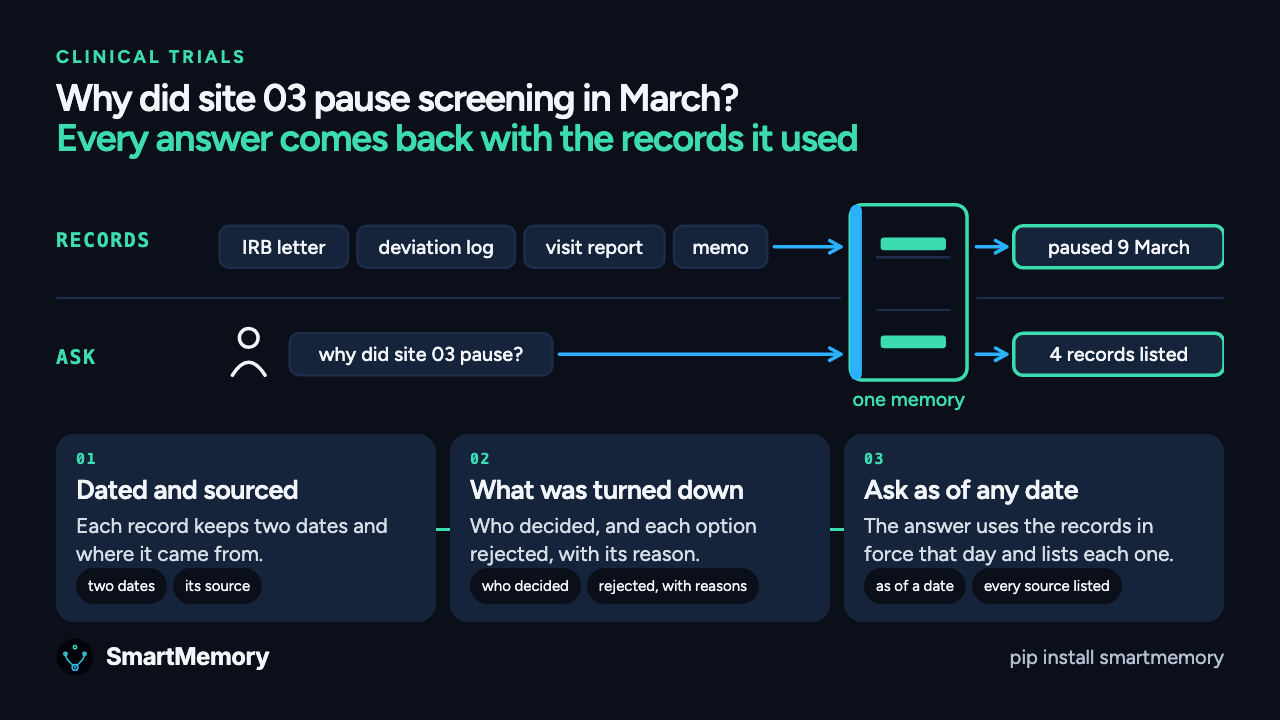
One Phase II study, four questions
Read the transcript
Corvane Therapeutics runs a Phase II study in ulcerative colitis. A hundred and twenty participants, four sites, one shared memory.
Why did site 03 pause screening in March? Two participants signed consent on the old form, after their local review board approved the new one.
Screening paused on the ninth of March. Participants already in screening could finish, once re-consented. It resumed five weeks later.
In February, after a serious liver event, the medical monitor recommended keeping dose level 2 at two hundred milligrams, with weekly liver tests for the first eight weeks. The record keeps the three options turned down, each with its reason.
Two serious adverse events, two clocks. The first was reported in under eight hours. The second, on a Saturday, took forty-nine, because the on-call sub-investigator had no reporting account.
Which consent form applied at site 03 on the third of March? Version three, approved locally the day before. Change the date, and the answer changes.
Every record keeps its date and its source. It does not replace your EDC or CTMS, and it makes no clinical decisions.
Keep the reasons with the records. SmartMemory.
The facts exist. The thread between them gets lost.
The facts exist. The thread between them is what gets lost.
In March, new screening stops at one site of a Phase II study. The study on this page and in the film is invented: Corvane Therapeutics, compound KVR-417, 120 participants at four US sites, monitored by a CRO called Meridale Clinical Research.
When an auditor or a new study lead asks why, the answer is spread across a protocol amendment, a local IRB letter, a deviation log, a monitoring visit report, a decision memo and a follow-up visit, written by different people weeks apart.
Nobody here is careless. The EDC, the CTMS and the trial master file hold their records well. What they hold less well is the reasoning that connects them, and it is lost at three moments: between monitoring visits, across amendments and when people change roles.
How it works in a study
- Step 1
Every record keeps its date and its source.
Visit reports, deviations, SAEs, IRB approvals, procedures and decisions go in as they happen. Each keeps two times, when it was true in the study and when it was recorded, and where it came from. An SAE keeps its awareness time and its report time, so a missed 24-hour clock shows, with the reason.
- two dates
- its source
- Step 2
A decision keeps what was turned down.
In February the medical monitor recommended keeping dose level 2 at 200 mg with weekly liver tests for the first eight weeks, and the study lead decided. The record names both, and keeps the three options rejected: stop the arm, cut it to 150 mg, or wait for the May DMC.
- who decided
- rejected, with reasons
- Step 3
Ask as of any date, and get the records back.
Ask which consent form site 03 should have used on 3 March 2026 and the answer is ICF 3.0, approved by the site's local IRB the day before. Every answer is built from stored records and lists the records it used, so a reviewer can open each one.
- as of a date
- every source listed
One question, asked months later
YouWhy did site 03 pause screening in March, and when did it resume?
New screening at site 03 was paused on 9 March 2026. Two participants had signed consent on the superseded ICF 2.0 on 3 and 4 March, after the site's local IRB approved ICF 3.0 on 2 March. Participants already in screening could finish once re-consented on ICF 3.0. Both were re-consented on ICF 3.0 on 11 March and randomized later that month. The CRA checked the corrective action on site on 8 April, and screening resumed on 13 April, five weeks after the pause.
- 2 March
- Local IRB approves ICF 3.0. Version 2.0 is superseded for new consents.
- 3 and 4 March
- Two participants consent on ICF 2.0. Logged as two important deviations.
- 6 March
- The monitoring visit finds both and escalates them the same day.
- 9 March
- Pause new screening. Rejected: close the site, or retrain and keep screening.
- 13 April
- Screening resumes, after the on-site CAPA check of 8 April.
Tested, with the method shown
25 of 25
Right about past decisions
A notes file edited in place got 1 to 3. Synthetic questions, two seeds, two models.
Every change is kept, with its history
Decisions are never silently overwritten. One call shows where a memory came from, what it replaced, and whether its history checks out.
Questions clinical operations teams ask
Does it replace the EDC or CTMS?
No. The EDC, CTMS, eTMF and safety database remain the systems of record. The memory holds the context around their records and points back to them. A document that belongs in the trial master file stays in the trial master file.
Does it make clinical decisions?
No. It records the decisions people make and the reasons they give. It does not assess causality, expectedness, eligibility or dose. Medical judgment stays with the investigator, the medical monitor and drug safety.
Does it send SAE reports?
No. It can show that a reporting clock was missed and why. In the example study one SAE was reported 49 hours 15 minutes after awareness, against 24, because the on-call sub-investigator had no eSAE account. It does not send expedited reports or notify regulators.
What regulatory claims do you make?
None. We make no claim about the regulatory status of SmartMemory. Whether and how to use it in a regulated process is for the sponsor's own quality and computerized system assessment. What it does offer is an audit trail: each version of a record is kept, versions are linked so a later change to that history is detectable, and a workspace can be exported.
Should participant names go in?
No. Put in what trial records already contain: participant numbers, not names. The memory does not need direct identifiers to be useful.
Is the study real?
No. Corvane Therapeutics, KVR-417, Meridale Clinical Research, the four sites, the review boards and every person on this page and in the film are invented.
Keep the reasons with the records.
Facts, events, procedures and decisions, with their dates, their sources and the options turned down. Start with one command.
pip install smartmemoryOther teams, other weeks
- On callFour engineers solved the same outage four times in one week
- CodingYour codebase records what got built, not what got rejected
- AgentsYour AI agents never tell each other what they learned
- SupportCustomer context is not the same as remembering
- SalesThe one thing you need before the next call is not in your notes
- ComplianceEleven months later, somebody asks you to show why
- HealthcareFour clinicians, one chart, one missing sentence
- FinanceWhy does the desk own this? Nobody can say.
- LegalYour firm already answered this, last year, in another file
- RoboticsA robot stopped in aisle nine. The same fault happened ten days ago.